




Premier League Weekend Analysis: Control and Margins
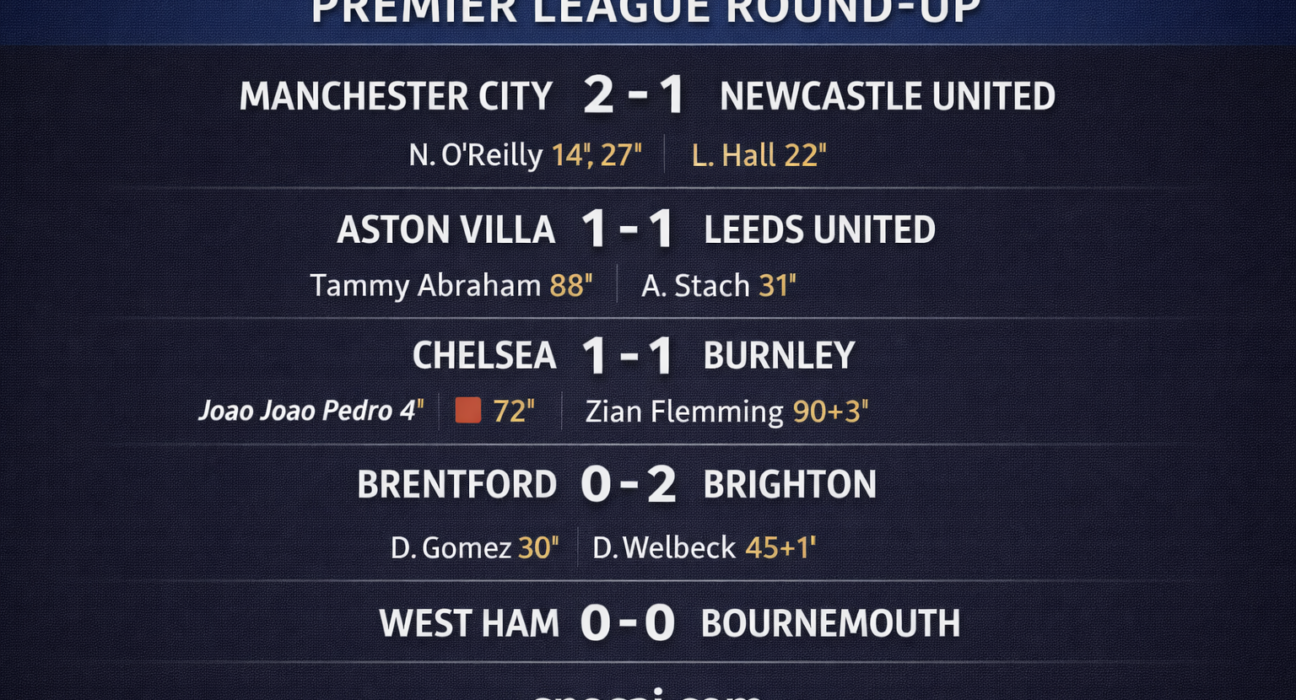
Premier League Round-Up: Control, Discipline and the Margins That Matter
Premier League Weekend Analysis: A Measured Round
This Premier League weekend analysis does not begin with drama. There are rounds of Premier League football that linger because of drama. This one lingered for different reasons. The noise was lower, the margins tighter, and the detail more revealing than the scorelines might initially suggest.
At the Etihad, Manchester City’s 2–1 win over Newcastle United was not built on spectacle. It was built on control. City had 56 per cent of possession and completed over 400 passes, but the more telling element was composure. Even during Newcastle’s more assertive pressing phases, there was no sense of disorder. City recycled possession calmly, slowed the tempo when required and accelerated only when space opened.
Newcastle were competitive — six shots on target away from home is evidence of that — yet the balance of the contest rarely shifted decisively in their favour. City did not need to dominate every phase; they only needed to manage them. It was a measured performance, consistent with a side comfortable in its own structure.
Aston Villa’s draw with Leeds United unfolded differently. Villa controlled 74 per cent of the ball and passed with notable accuracy, yet the match never felt beyond Leeds’ reach. Much of Villa’s possession came in front of an organised defensive block. The circulation was tidy, the territory significant, but central access remained restricted.
Leeds, by contrast, required fewer moments to influence the outcome. Their direct transitions carried greater clarity. The 1–1 result reflected that balance. It was not a case of Villa lacking effort; it was a case of control without sustained incision.
Chelsea’s afternoon against Burnley carried a similar tension. The statistical profile suggested authority — 67 per cent possession and nearly 600 completed passes — yet the rhythm of the match was disrupted by discipline. Once reduced in numbers, Chelsea’s progression became more predictable. Burnley narrowed spaces intelligently and forced play wide, reducing the threat in central areas.
The result was a contest shaped more by structure than momentum. Chelsea retained the ball, but Burnley retained their shape. Over time, that proved equally influential.
Brighton’s performance at Brentford offered a reminder of efficiency. Possession was almost evenly split, but the difference lay in execution. Brighton placed seven of their eleven attempts on target, while Brentford managed three from fourteen. That gap, modest on paper, was decisive in practice.
Brighton did not chase control for its own sake. They waited for moments and responded with precision. It was a mature display from a side increasingly comfortable operating without territorial dominance.
West Ham and Bournemouth produced a goalless draw that reflected mutual caution rather than inactivity. Bournemouth held more possession and passed with greater accuracy. West Ham generated more attempts. Neither side allowed the game to stretch beyond manageable distances between the lines. Defensive organisation remained intact throughout.
Across the round, a consistent theme emerged. Possession alone carried less authority than it once did. Shot accuracy mattered more than volume. Teams appeared increasingly willing to concede territory if it meant protecting space. Structure often proved more valuable than spectacle.
The intensity of the Premier League remains unchanged. What is evolving is the manner in which matches are controlled. There is a greater sense of calculation now, a sharper understanding of when to accelerate and when to contain.
It was not the loudest weekend of the season. It may, however, have been one of the more instructive.
There is also a noticeable psychological shift in several sides. Fewer teams appear willing to lose structural shape in pursuit of volume. Defensive spacing, particularly between midfield and back lines, was consistently disciplined across the round. That level of coordination rarely happens by accident.
It suggests preparation rather than impulse. And over a 38-game Premier League season, preparation tends to outlast spontaneity.