

Manchester United’s Problem Isn’t the Red Card — It’s Control
Manchester United’s Problem Isn’t the Red Card — It’s Control
There are games you can explain away afterwards.
And then there are the ones that leave a slightly different feeling — even when the scoreline looks manageable.
This felt like one of those.
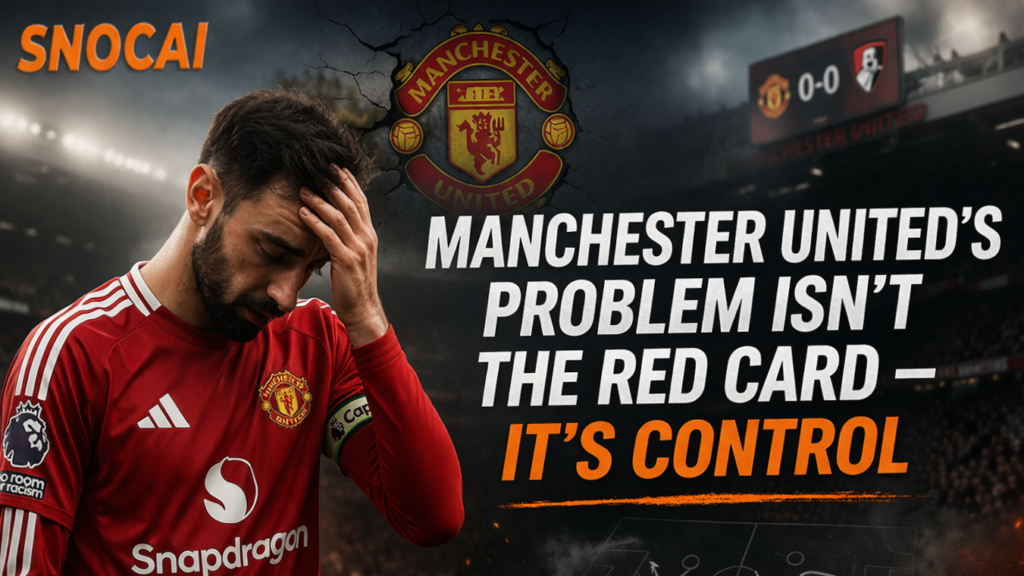
Yes, the red card mattered. It always does. But even before that moment, something didn’t quite sit right about the way Manchester United were playing.
Not wrong, exactly.
Just… not convincing.
Manchester United Analysis: A Game That Never Quite Belonged to Them
It wasn’t chaotic. That’s the strange part.
United had the ball at times. They moved it reasonably well. There were moments where it looked like things might settle.
But it never really did.
Bournemouth didn’t dominate in a traditional sense, yet they looked more certain — more aware of what they wanted the game to be. And that difference, even when it’s subtle, tends to show over time.
Why the Red Card Isn’t the Story
Red cards give you something to point at.
A moment. A turning point. An easy explanation.
But this didn’t feel like a game that changed suddenly.
It felt like one that was already drifting.
Even with eleven players on the pitch, United weren’t fully in control of the tempo. They reacted to phases rather than shaping them. And once a team slips into that pattern, it’s difficult to reverse it mid-game.
Moments That Don’t Quite Build
“We need to manage games better,” one United player said afterwards.
It sounds like a standard post-match line.
But watching the game, it didn’t feel empty.
United create moments — a chance here, a short spell there — but they rarely seem to extend them. The game doesn’t bend around them for long enough.
And that’s usually where control comes from.
Something Slightly Unsettled
There is quality in the squad. You can see it in flashes.
But the structure around it still feels… not unfinished, exactly — just not fully settled.
At times, players look a fraction too far apart. Transitions feel a bit too open. When possession turns over, the shape doesn’t always hold.
None of this is dramatic on its own.
But over 90 minutes, it adds up.
Where That Leaves Them
This isn’t a collapse.
It doesn’t even feel like a crisis.
But it doesn’t feel stable either.
And that middle ground is uncomfortable — especially this late in the season, when most teams already know what they are.
United still seem to be figuring that out.
So What’s Actually Missing?
Not intensity.
Not effort.
Something quieter than that.
The kind of control that doesn’t always stand out — but becomes obvious when it isn’t there.
There’s also a sense that games involving Manchester United never fully settle.
Even when they take the lead, the rhythm rarely feels controlled for long stretches. Opponents stay in the game, chances remain open, and the balance never quite shifts in their favour.
That lingering uncertainty — more than any single moment — is what defines their performances right now.
More Premier League Analysis
Explore weekly breakdowns, tactical insights and in-depth features on snocai.com