




Liverpool 4–1 Newcastle United: Tactical Dominance Explained
Liverpool 4–1 Newcastle United: Tactical Dominance, Ruthless Finishing and a Statement Win
Liverpool vs Newcastle match analysis shows how Liverpool controlled the game from start to finish in a commanding 4–1 Premier League victory at Anfield. Liverpool produced one of their most authoritative performances of the Premier League season with a convincing 4–1 victory over Newcastle United at Anfield. While the scoreline suggests a comfortable night, the match itself revealed a deeper tactical story—one built on pressing structure, midfield control and decisive moments in transition.
This result was not simply about goals; it was about how Liverpool imposed their identity against a Newcastle side that struggled to cope once momentum shifted.
🧠 Tactical Overview: Control vs Transition
Liverpool’s Structured Aggression (4-2-3-1)
From the opening minutes, Liverpool set the tempo with a compact 4-2-3-1 shape. The double pivot ensured defensive stability while allowing creative players freedom between the lines.
Liverpool’s positional play was especially effective in central zones. Their ability to recycle possession quickly forced Newcastle into narrow defensive blocks, creating space wide and between midfield and defence.
Key tactical features:
-
High defensive line with aggressive recovery runs
-
Quick vertical passing once possession was regained
-
Overloads in half-spaces to disrupt Newcastle’s midfield shape
Newcastle United’s Reactive Approach (4-3-3)
Newcastle United began with a balanced 4-3-3, aiming to stay compact and break through pace on the wings. For a brief period, this plan worked.
However, once Liverpool increased their pressing intensity, Newcastle struggled to progress the ball cleanly. Long passes replaced structured build-up, leading to repeated turnovers in midfield areas.
This Liverpool vs Newcastle match analysis highlights how tactical discipline and pressing efficiency shaped the final scoreline.
⚽ Key Moments That Defined the Match
Newcastle’s Early Reward
Against the flow of play, Anthony Gordon capitalised on a rare opening to put Newcastle ahead in the 36th minute. It was a reminder of Newcastle’s threat on the break—but also their reliance on isolated moments rather than sustained pressure.
Hugo Ekitike’s Decisive Brace
The match turned dramatically just minutes later. Hugo Ekitike struck twice in quick succession (41’ and 43’), punishing defensive indecision and poor tracking in central areas.
These goals exposed Newcastle’s vulnerability when forced to defend deep under sustained pressure.
🎯 Second-Half Control and Ruthlessness
After the break, Liverpool showed maturity. Rather than chasing the game emotionally, they slowed the tempo, recycled possession and waited for openings.
Florian Wirtz’s Influence
Operating between the lines, Florian Wirtz dictated attacking rhythm. His goal in the 67th minute came from intelligent positioning rather than raw pace, highlighting Liverpool’s tactical intelligence.
Defensive Authority
At the back, Liverpool remained composed. Virgil van Dijk and Ibrahima Konaté controlled aerial duels and second balls, neutralising Newcastle’s late attempts to push forward.
Konaté’s stoppage-time goal from a set-piece was a fitting end—symbolic of Liverpool’s dominance in both open play and dead-ball situations.
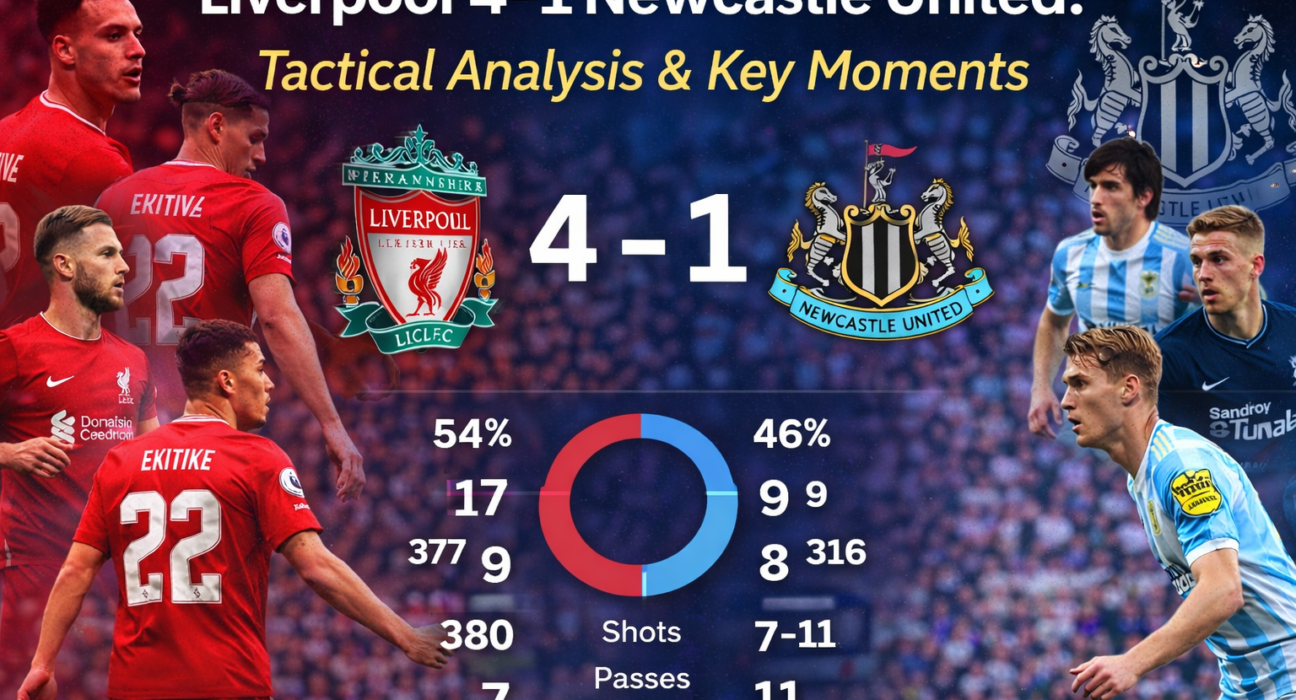
Liverpool vs Newcastle Match Analysis: Tactical Overview
📊 Match Statistics Tell the Story
Liverpool’s superiority was reflected across key metrics:
-
Higher shot volume and accuracy
-
Superior pass completion under pressure
-
Better control of central areas despite Newcastle earning more corners
Newcastle’s inability to convert set-pieces into genuine chances ultimately underlined the gap in execution.
🔍 What This Result Means Going Forward
For Liverpool, this was a statement performance. The balance between creativity and control suggests a side comfortable managing different game states—an essential trait in title contention.
For Newcastle, the match highlighted ongoing concerns:
-
Difficulty maintaining structure after conceding
-
Limited midfield resistance under high press
-
Over-reliance on individual attacking moments
🏁 Final Verdict
Liverpool’s 4–1 win was not just about goals—it was about authority. They responded to adversity, controlled momentum and executed their tactical plan with precision. Newcastle, meanwhile, will need to address structural issues if they are to compete consistently against elite sides.
At Anfield, this felt like more than three points. It felt like a reminder of Liverpool’s ceiling.
Overall, this Liverpool vs Newcastle match analysis underlines the gap in control, structure and game management between the two sides.